Koh Samui ATMs & Currency Exchange: Fees, Prices & the Smartest Way to Get Baht (2026)
The new 2026 ATM fees, the cheapest machines on the island, and where your dollars actually go furthest.
- Thai ATM fees are 250 baht on Visa and 350 on Mastercard, so use Visa.
- Withdraw larger amounts less often, and look for AEON ATMs in hypermarkets.
- Always decline currency conversion and pay in baht at ATMs and card terminals.
- Bring crisp $100 bills and exchange them in Bangkok or at Central Festival Samui.
Here's a happy little secret about Samui Island, Thailand: getting baht is the easiest thing you'll do all trip (right after falling asleep on a beach lounger). ATMs sit on practically every corner, and exchange booths line the main roads. Once that cash is in your pocket, Koh Samui prices work in your favor fast. Street stall pad thai runs 60 to 150 baht, and an hour of Thai massage at a neighborhood shop is around 250 to 400. Here's exactly how I get my cash, so more of it goes to the fun stuff.

Cash or Card on Koh Samui?
Both, honestly.
Cards work great at:
- Resorts and hotels
- Central Festival and the bigger mall shops
- Sit-down restaurants and the nicer spas
Cash is king at:
- The Fisherman's Village night market, where most stalls don't take cards at all
- Every Koh Samui songthaew (those shared pickup trucks), plus taxis at the end of a night out
- Small massage shops and beach vendors
- Temple stops like Wat Plai Laem, where a bag of fish food costs 20 to 50 baht
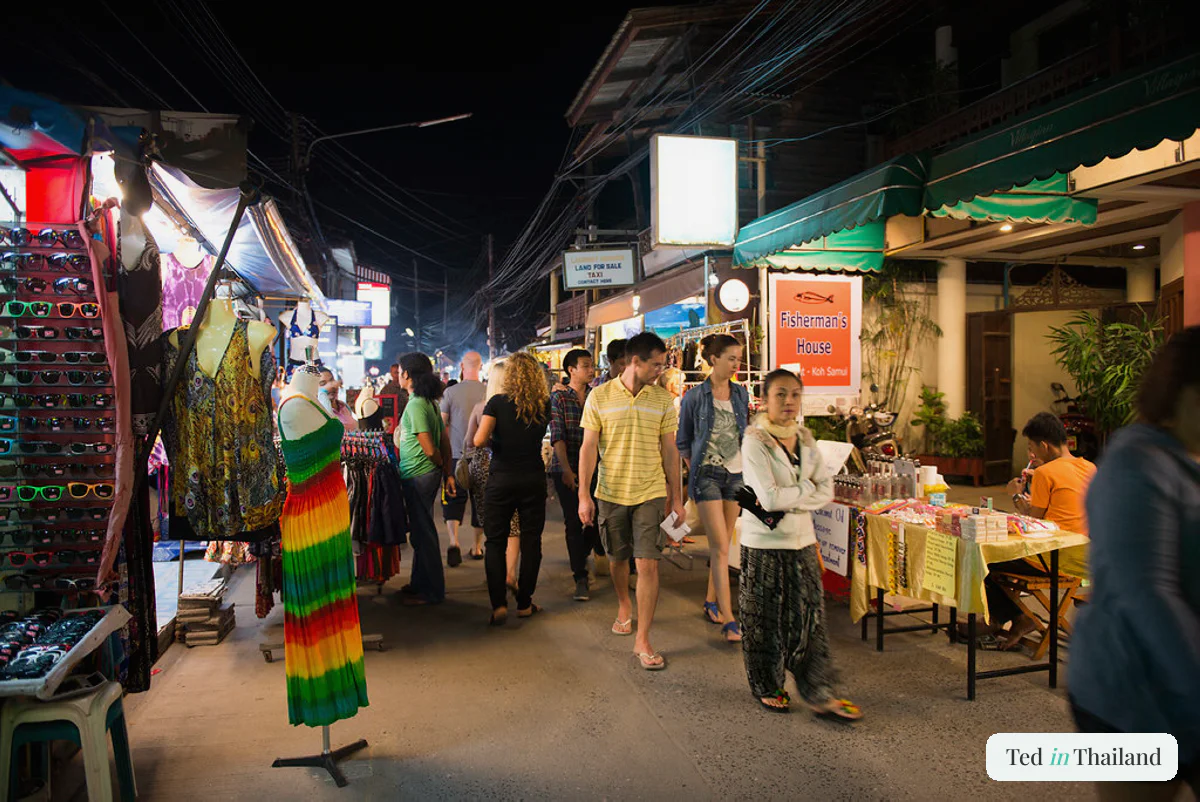

Small notes matter. Plenty of stalls can't break a 1,000 baht note, so I treat my 20s, 50s, and 100s like gold and break big bills at 7-Eleven.

Koh Samui ATM Fees (and How to Shrink Them)
Every Thai bank ATM charges a flat fee when you use a foreign card, and that fee went up in 2026. At the big banks like Kasikorn (KBank), Krungsri, and SCB, it's now 250 baht per withdrawal on a Visa and 350 baht on a Mastercard. Yep, the logo on your card matters. Your home bank may add its own fees on top.
Since the fee is flat, the math is simple. With a Visa:
- Withdraw 2,000 baht and the 250 fee eats 12.5%
- Withdraw 10,000 baht and it drops to 2.5%
- Withdraw 20,000 baht and it's just 1.25%
Most machines cap a single withdrawal somewhere between 20,000 and 30,000 baht, so I go big, go rarely, and lock most of it in the hotel safe.
The Cheapest ATMs on the Island
AEON machines are the happy exception at 150 baht per withdrawal. You'll usually find them inside the big hypermarkets like Big C, Lotus's, and Makro, so I time my withdrawals with a grocery run.
Always Say No to "Convert"
The screen will offer to charge you in your home currency. Decline it every time and choose THB. That "convenient" conversion (called DCC) is almost always a few percent worse than your card's own rate. Same rule at restaurant card terminals.
Ted's Tip
If you carry both a Visa and a Mastercard, use the Visa at Thai ATMs and save 100 baht every time, and pair it with a card that has no foreign transaction fees (like Capital One 360 for Americans) so the only charge you pay is the local ATM fee shown on screen.
Where to Find the Best ATMs
Machines are everywhere along Chaweng Beach Road, through Lamai, and around Bophut, but they aren't all equal. My favorites sit inside or attached to a bank branch. Skimmers are far less likely there, and if a machine swallows your card, staff can usually return it (with your passport) during business hours. Try that with a lonely ATM outside a bar at midnight.

ATMs at Koh Samui Airport
The ATMs at Koh Samui Airport charge the same fee as anywhere else, so pulling cash there is fine. The exchange counters are another story, with rates usually weaker than in town.

Still figuring out the ride from the airport to your hotel? My Koh Samui transport guide covers every option.
When friends ask about safety in Koh Samui, ATMs barely make my list, but skimming does happen. Wiggle the card slot for anything loose, cover your PIN, and turn on instant banking alerts. My full safety guide covers scams in more detail.
Those banking alerts need mobile data, so get connected before you land. I compare the options in my Thailand SIM card and eSIM guide.
Currency Exchange on Samui: Booths vs. Banks
Bringing dollars, euros, or pounds? Exchange booths are all over Chaweng Beach and Lamai, and decent ones land within about 1 to 3% of the real rate. Check the live rate on your phone first, and be skeptical of big "No Commission!" signs, which often hide a weaker rate.
Banks at Central Festival Samui
My go-to for changing larger amounts is the cluster of bank exchange counters inside Central Festival Samui. Krungthai's counter there consistently gives me solid rates, and the booths nearby have to compete with it. Bring your passport, because banks will ask for it.
Bring the Right Bills
Thai exchangers are picky. Crisp, newer $100 bills (the ones with the blue security strip) get the best rate. Smaller bills like $20s get a noticeably lower rate, and anything torn, written on, or stained can be turned down completely.
Flying from Bangkok to Koh Samui? Exchange the bulk of your cash in Bangkok first. Places like SuperRich and Vasu there usually beat anything you'll find on the island.

Ted's Tip
Count your baht at the window before you walk away, and make sure the total matches the rate on the board times your amount, because an honest mistake is much easier to fix while you're still standing at the counter than it is an hour later at the beach.
Smart Cash Habits for Your Trip
- Split your cash between your wallet and the hotel safe
- Keep a backup card in a different bag
- Always pay drivers in baht, since foreign currency invites a "creative" exchange rate
For what a whole trip actually costs, my budget guides and money FAQ break it all down.
If your wallet ever goes walkabout, the right cover makes it a lot less painful. Here's my pick of the best travel insurance for Thailand.
Conclusion
Money on Samui is simple once you know the rules. Withdraw big, hunt down AEON machines, reach for your Visa, and say no to "convert" every time. Carrying cash? Bring clean $100s and change them at a bank counter or in Bangkok. Do that, and your Koh Samui travel budget goes to sunsets and seafood instead of fees.

FAQ
How much is the ATM fee in Koh Samui?
At the major Thai banks, it's 250 baht per withdrawal on a foreign Visa and 350 baht on a foreign Mastercard. AEON ATMs are cheaper at 150 baht.
Is it better to exchange money or use ATMs on Koh Samui?
For most visitors, a no-foreign-fee card at an ATM is the simplest option, especially with large withdrawals. If you're carrying crisp $100 bills, a bank exchange counter can be just as good or better.
Can I use my credit card on Koh Samui?
Yes, at hotels, malls, and most sit-down restaurants. Markets, songthaews, and small shops are mostly cash only.
Where is the best place to exchange money on Koh Samui?
I like the bank exchange counters inside Central Festival Samui. If you're connecting through Bangkok, exchanging there first usually gets you an even better rate.
How much cash should I budget for Koh Samui?
It depends on your style, but I keep enough on me for a day or two of markets, transport, and tips, and lock the rest in the safe. My budget guides have full daily numbers for every type of trip.
Should I bring US dollars to Thailand?
It's a solid backup. Bring newer $100 bills in perfect condition, since damaged or smaller bills get worse rates. It's one of the most useful Thailand tips I can give anyone flying in.